
Sales Kickoff and Q1 Offsite Boxes: Ordering in December for a January Event
Pacific Gift Box Co.
·Published September 8, 2026 · Updated October 24, 2026
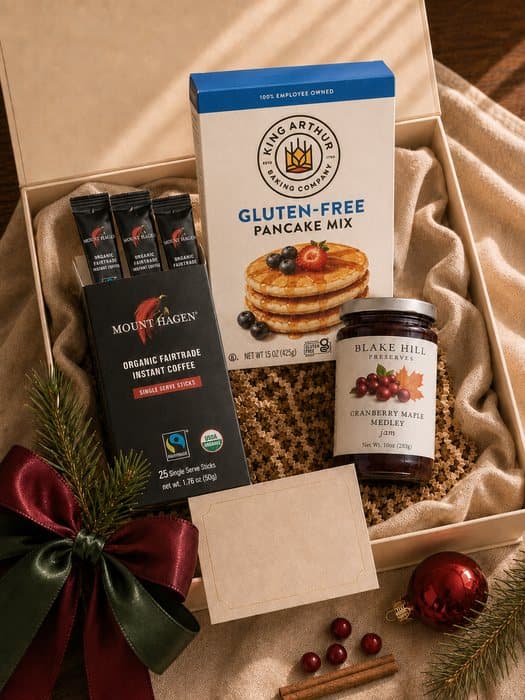
When a sales kickoff or Q1 offsite lands on the calendar in January, the gifting window is December — and it closes faster than most planners expect. Sales kickoff gift ideas are the curated, intentionally chosen items given to attendees at the start of a new fiscal year to set the tone, build team cohesion, and signal that the event was worth traveling for before a single slide deck opens. Done right, a welcome box lands in a guest room the night before and communicates, without a word from the presenter: this event was worth coming to.
Whether you're an event coordinator managing a 40-person national sales meeting at a hotel, or a planner tasked with pulling together a Q1 leadership offsite, what you put in — and leave out of — those boxes matters more than the budget line suggests. This guide walks through what actually works, what gets thrown away, and how to order in December without losing your mind.
A well-chosen three-item box placed in a guest room the night before a sales kickoff does more for team tone than any branded tote assembled in a hotel hallway at midnight.
2026 order-by dates
| Order type | Thanksgiving | Christmas |
|---|---|---|
| Non-branded, shipped nationwide | Tue, Nov 10 | Mon, Dec 14 |
| Non-branded, SoCal, 50+ boxes | Tue, Nov 17 | Fri, Dec 18 |
| Custom-branded (logo, ribbon, inserts) | Fri, Oct 23 | Fri, Nov 20 |
Boxes run $59–$179, shipping included. Orders start at 12 boxes; custom and logo-branded boxes start at 100. See the Holiday Collection and get a quote.
Why Sales Kickoff Gift Ideas Deserve More Thought Than Branded Swag
The Difference Between a Gift and a Logo Vehicle
There's a gap between a box full of branded pens, a lanyard, and a stress ball — and a box that a sales rep genuinely uses during their stay and remembers on the flight home. Most swag serves the brand's ego, not the recipient's experience. A thoughtful welcome box, by contrast, contains things a person would actually choose: a quality snack for the late-night prep session, something to drink that isn't the minibar, a card that feels human rather than printed by a fulfillment center.
Recognition tends to be most effective when it feels personal rather than generic. That distinction carries directly into kickoff gifting: a box that feels assembled by a person reads as appreciation; a bag that feels printed at a trade show reads as obligation. This matters especially for sales teams. They travel constantly. They've seen every variation of the branded tote bag. The bar for "impressive" is higher, which means the bar for "forgettable" is lower.
What Actually Gets Used vs. What Gets Left Behind
Items that consistently get used:
- Quality snacks — something a little elevated, not what they'd grab at an airport
- A real beverage — sparkling water, a canned cocktail, or a specialty coffee single-serve
- One tactile, useful object — a notebook they'll actually write in, a candle for the room, a good lip balm in winter
- A handwritten or high-quality printed note — almost always the item that gets photographed and shared
Items that end up in the hotel trash:
- Stress balls, fidget items, foam anything
- Branded USB drives (nobody uses them)
- Generic candy in bulk packaging
- Anything that requires assembly or has no obvious purpose
The principle is simple: fewer, better. A well-chosen three-item box beats a stuffed bag every time — and it photographs better, ships cleaner, and costs less per meaningful impression. Useful items tend to be kept; novelty items tend to be discarded. The same logic applies inside a kickoff box: useful beats impressive every time.
Why Hoteliers and Venue Coordinators Care About This Too
For hoteliers managing group room blocks, the quality of a welcome box reflects directly on the property — even when it was ordered by a corporate planner, not the hotel itself. Guests don't distinguish between "the hotel put this here" and "the event organizer sent this." When boxes are pre-packed, labeled, and shipped directly to the receiving dock, the hotel's turndown team places them efficiently and the guest experience is seamless. When a planner shows up with 60 unmarked bags and asks for a storage room, that's a friction point that lands in post-event reviews.
Ordering in December for a January Sales Kickoff: The Real Timeline
Why December Is Already Late (and How to Move Fast)
Most Q1 kickoff events land in the first three weeks of January. That means the packing and delivery window is the last two weeks of December — a period that includes holiday shipping surges, reduced vendor hours, and hotel receiving cutoffs. The IRS caps business gift deductions at $25 per recipient per year under IRS Publication 463 (Travel, Gift, and Car Expenses), so if budget conversations are still happening in December, they needed to start in November. Get that number confirmed before you pick a box tier.
A realistic December-to-January order timeline looks like this:
- Early December: Confirm guest count, hotel, and receiving logistics. Get a certificate of insurance from your vendor if the hotel requires one.
- Mid-December: Finalize box selections and any personalization (custom cards, branded tissue, etc.). Submit the order.
- Just before the holidays: Confirm shipping window with the vendor. Most hotels will not receive packages more than 3–5 days before an event.
- Late December: Coordinate hotel delivery with the catering or events manager. Confirm room-drop logistics and timing.
- January (event week): Boxes arrive pre-packed, labeled by room or guest name, ready to place — no assembly in a hallway the night before.
Coordinating with the Hotel Receiving Team
This is where most planners hit friction. Hotels have receiving docks, limited storage, and specific room-drop fees. Know these three things before you order:
- What is the hotel's earliest package acceptance window before the event?
- Does the hotel charge a room-drop fee per box? (Many charge $3–$8 per room.)
- Who is your point of contact in the events or banquet department — not the front desk?
Working with a vendor who ships directly to the venue, pre-packed and labeled, removes one full layer of logistics from your plate. You're not schlepping boxes. You're not recruiting a colleague to stuff bags at 11pm. The boxes arrive ready. For hoteliers coordinating on the property side, a vendor who communicates directly with your receiving dock and provides a packing manifest saves significant back-office time during a period when your team is already managing multiple group arrivals.
A Hypothetical That Illustrates the Stakes
Take a corporate event coordinator managing a 55-person national sales kickoff at a full-service hotel outside Chicago. The event is January 14th. She needs boxes for 55 rooms, a personalized printed card with the VP of Sales' signature, and direct delivery to the hotel's receiving dock on January 12th. She has no interest in coordinating fulfillment herself or asking the hotel to assemble anything the night before.
The clean solution: pre-packed, room-labeled Essential Boxes shipped to the hotel dock two days before the event. The hotel events team places them during afternoon turndown. By the time attendees check in, the boxes are waiting — no coordinator in the hallway, no last-minute scramble. That's what well-executed sales kickoff gift ideas look like when the logistics are handled end-to-end.
Choosing the Right Box Tier for a Sales Kickoff
Matching the Box to the Audience and Occasion
Not every kickoff needs the same box. A regional team huddle has a different tone than a national leadership summit. Below is a practical comparison to help narrow the choice. For exact current pricing and what's available at each tier, visit our gift builder.
| Event Type | Audience | Recommended Tier | What to Prioritize |
|---|---|---|---|
| Regional sales meeting | Field reps, 20–60 people | The Essential Box ($89) | Snacks, beverage, card — clean and energizing |
| Q1 kickoff with entertainment | Mixed team, 40–100 people | The Premium Box ($129) | Shareable snacks, more substantial contents for a longer stay |
| Executive leadership offsite | C-suite, VPs, directors | The Reserve Box ($179) | Premium items, elevated presentation, bespoke note |
| Hotel welcome for invited clients | Key accounts, guests of honor | The Reserve Box ($179) | Personalization, quality over quantity, memorable detail |
Orders start at 12 boxes, with custom or logo-branded orders starting at 100 — but within that, you can mix tiers freely. If the executive team gets The Reserve Box and the broader attendee list gets The Essential Box, you can do that. Count by room, not by head. For hoteliers managing a corporate buyout with tiered VIP designations, this flexibility matters: you're not locked into a single SKU across a 200-room block.
How Personalization Works at Scale
The most effective and operationally clean approach to personalization is a custom printed card — one that carries the team leader's name, a line from the VP of Sales, or a brief note from the event host. It reads as thoughtful without requiring individual customization per box. If guest-name cards on each box are important, provide a rooming list at the time of order and confirm with your hotel contact that named placement during turndown is feasible. Keep the box contents consistent; let the card carry the personal weight.
What to Skip When Briefing Your Vendor
Requests That Sound Good but Underdeliver
When planners brief a gifting vendor in December, a few requests come up repeatedly that are worth reconsidering:
- "Can we add the company logo to everything?" — A single branded card or tissue wrap is enough. Logo-on-every-item turns a gift into a merchandise catalog.
- "Can we include the event agenda in the box?" — Print it separately. An agenda in a gift box reads as administrative, not generous.
- "We want it to feel luxurious but keep it under $20." — That's a price point for a card and a chocolate bar, not a box. Be honest with stakeholders about what quality costs. The Essential Box tier starts at $89 for a reason.
- "Can each box have a different item for each person?" — Per-person customization at scale is an operational nightmare. A thoughtful standard box with a personalized note is more effective and infinitely more manageable.
The Filler Problem
The single most common mistake in corporate gifting is filling space for the sake of filling space. A box that looks full is not the same as a box that feels considered. Foam peanuts, generic hard candies, and promotional keychains all signal that someone was working against a volume target, not a guest experience. The boxes that get remembered — and photographed, and mentioned on the first morning of a kickoff — are the ones where every item had a reason to be there. Good sales kickoff gift ideas are edit decisions as much as selection decisions.
This is general information, not tax advice. What your company can deduct, and what counts as taxable income to the recipient, depend on your entity, who receives the gift, and how it is documented — confirm with your tax professional.
Frequently Asked Questions
Q: How far in advance should I order sales kickoff gift boxes for a January event?
A: Order as early in December as possible to allow time for customization, packing, and coordinated hotel delivery before the holiday shipping crunch. If your event is in the first week of January, plan even further ahead. The closer you get to the holidays, the more logistics compress — and hotel receiving windows don't flex for late orders. Build in a buffer for hotel confirmation of receiving dates, since that step alone can take 48–72 hours to resolve through the right department contact.
Q: Can I order different box tiers for different attendee groups at the same event?
A: Yes — ordering separate tiers for executives versus general attendees is common and straightforward. An order of ready-made boxes starts at 12, so you might order a dozen or more Reserve Boxes for the leadership team and a larger batch of Essential Boxes for the broader group, all shipping to the same hotel. Provide a labeled rooming list at the time of order and coordinate placement with the hotel's events or banquet contact, not the front desk. The hotel places them; you're not managing inventory on-site.
Q: What makes a sales kickoff gift box different from a standard wedding welcome bag?
A: The contents and tone differ, but the operational logic is identical — and that's the point. Both benefit from pre-packed boxes shipped directly to the venue that arrive labeled and ready for turndown placement. Both fail when someone is assembling them in a hotel room the night before. For a sales kickoff, the emphasis is on energizing, professional, and functional items. For a wedding welcome, it's warmth, local flavor, and celebration. The tier structure works for both contexts, and since an order of ready-made boxes starts at 12 (100 for custom or logo-branded orders), you can run them simultaneously for a corporate group block and a co-located wedding room block without combining or compromising either.
Ready to send? Tell us your head count and whether it's one address or many — get a quote on the Holiday Collection or build your own box. We reply within one business day. Christmas orders: Mon, Dec 14 for shipped boxes, Fri, Nov 20 if you want your logo on them.
Looking for wedding & hotel welcome boxes? See The Turndown →
Related: Hotel gift box supplier
Request welcome-box pricing
Tell us the event, guest count, and dates — we'll reply with ideas and pricing. Orders start at 12 boxes.