
Take-Home Boxes for a 40-Person Holiday Party or Year-End Offsite
Pacific Gift Box Co.
·Published September 9, 2026 · Updated October 24, 2026
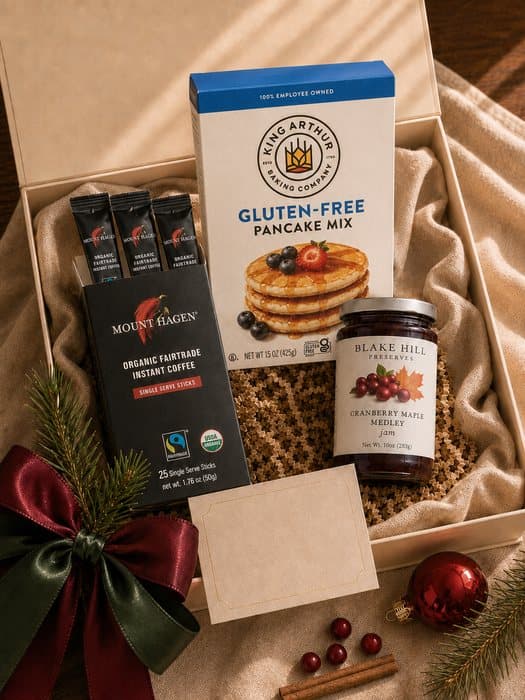
Planning take-home boxes for a 40-person holiday party or year-end offsite is one of those tasks that looks simple on a spreadsheet and turns complicated fast. Holiday party favors for staff are the tangible, packaged gifts employees bring home at the end of a company celebration — distinct from on-site catering, swag tables, or raffle prizes. Done well, they extend goodwill past the event itself. Done poorly, they become the branded lanyard nobody asked for. This guide walks you through what actually works at the 40-person scale, how to time your order, and what to skip so your budget goes where it counts.
The distinction matters: a holiday take-home box is a recognition moment, not a marketing vehicle. Recognition — a physical, curated object chosen with the recipient in mind — lands differently than a logo item sourced at minimum order quantity. That difference in intent is exactly what separates the boxes employees talk about on the drive home from the ones that live in a desk drawer until the next office cleanout.
"A holiday take-home box is a recognition moment. When it's curated rather than branded, employees carry the memory of the gift home — not just the object."
2026 order-by dates
| Order type | Thanksgiving | Christmas |
|---|---|---|
| Non-branded, shipped nationwide | Tue, Nov 10 | Mon, Dec 14 |
| Non-branded, SoCal, 50+ boxes | Tue, Nov 17 | Fri, Dec 18 |
| Custom-branded (logo, ribbon, inserts) | Fri, Oct 23 | Fri, Nov 20 |
Boxes run $59–$179, shipping included. Orders start at 12 boxes; custom and logo-branded boxes start at 100. See the Holiday Collection and get a quote.
Why Holiday Party Favors for Staff Deserve More Strategic Thought
Recognition vs. Merch: Why the Distinction Pays Off
Most HR and office managers are handed a per-head budget, a date, and a mandate to "do something nice." The instinct is to order branded items in bulk — tumblers, socks, candles with a logo slapped on. That approach isn't wrong, but it's often inefficient. Teams with recognition programs tend to report lower turnover — and recognition that feels personal is a meaningful driver of that effect. A holiday take-home box is a recognition moment. It should feel like it was chosen by someone who thought about the person receiving it, not sourced from a vendor catalog at the lowest MOQ.
There's also a tax consideration worth knowing: the IRS caps the business gift deduction at $25 per recipient per year (IRS Publication 463). For a 40-person party, that's a real ceiling to plan around. It doesn't mean you can't spend more — it means amounts above $25 per person aren't deductible as gifts, so confirm with your finance team how this affects your budget classification.
Additionally, tangible, experience-tied gifts tend to be remembered longer than cash-equivalent recognition. That's the strategic case for investing in a well-packed box rather than defaulting to a gift card or a branded item that competes for drawer space.
What Employees Actually Keep vs. What Goes in the Trash
Here's an honest breakdown based on what consistently gets used versus quietly discarded:
- Kept and used: Quality consumables (specialty food, coffee, tea, chocolate), thoughtful self-care items, locally sourced products, anything that feels like a treat they wouldn't buy for themselves
- Kept briefly, then donated or regifted: Branded apparel in wrong sizes, generic candles, mass-market snack assortments
- Thrown away or drawer-dwelling: Logo stress balls, cheap pens, foam koozies, anything that screams "vendor booth"
- Appreciated but rarely used: Company-branded drinkware (people already have too many water bottles)
The pattern is consistent: consumables and curated products outperform branded hard goods almost every time. If the item can be enjoyed within a week, it's remembered fondly. If it requires finding storage space, it creates a small but real negative association. Light co-branding — a card, a branded tissue layer — reads as thoughtful. Four branded items reads as a marketing exercise.
Logistics for a 40-Person Take-Home Box Order
Forty people is a meaningful number — large enough that you need a real fulfillment plan, small enough that you don't need an enterprise gifting platform with a six-month onboarding contract. Here's what to think through before you place an order.
Venue Pick-Up vs. Direct-to-Home Shipping
You have two delivery models to choose from, and the right one depends on your team's setup:
- Venue delivery (bulk drop): All 40 boxes arrive at your event location ahead of time. Employees take them home that night. Simpler logistics on the vendor side, but you're responsible for storage at the venue and any last-minute headcount changes.
- Direct-to-home shipping: Each box ships to each employee's home address before or after the event. Ideal for distributed teams, remote employees, or anyone who can't attend in person. Requires collecting addresses (and confirming them — people move).
For hybrid or fully remote teams, direct-to-home is the only equitable option. If half your 40-person headcount is attending virtually, a take-home box that only goes to in-office attendees is a morale problem, not a solution. This is the same logic that applies when planning ahead for distributed teams — similar to what you'd consider when ordering Q1 offsite boxes in December for a January event, where shipping to scattered home addresses is often the default.
Timeline: When to Order for a December Event
December is the single most congested month in the gifting calendar. Carrier delays, product shortages, and studio backlogs are real. A practical timeline for a mid-to-late December party:
- 8–10 weeks out (October): Confirm headcount estimate, finalize budget per head, choose delivery model
- 6 weeks out (early November): Place your order; this locks in product availability and production slots
- 3–4 weeks out: Submit final headcount and shipping addresses (for home delivery) or confirm venue delivery date
- 1–2 weeks out: Confirm tracking or venue delivery window; communicate to employees so they know to expect a package
Waiting until the first week of December for a mid-December party is a gamble. It's not impossible, but you'll have fewer product options and less flexibility on shipping speed.
Choosing the Right Box Tier for Your Group
Not every holiday party has the same context. A year-end offsite for a senior leadership team warrants a different box than an all-hands holiday lunch. Use this comparison to think through what tier makes sense:
| Occasion | Recommended Tier | Starting At | Best For |
|---|---|---|---|
| All-hands holiday party (mixed seniority) | The Essential Box | $89/box | Broad headcounts, budget-conscious programs |
| Year-end team celebration or department offsite | The Premium Box | $129/box | Teams where retention and culture ROI matters |
| Senior leadership offsite or milestone celebration | The Reserve Box | $179/box | High-touch moments, executives, key contributors |
| Mixed in-person + remote attendees | The Essential Box or Premium Box (ship to home) | $89–$129/box | Equitable gifting across distributed teams |
Orders start at 12 boxes; custom and logo-branded boxes start at 100. If you have 40 people at one tier and want to send three executives something elevated, you can mix. You're not locked into one configuration for the whole headcount. See full tier details and request pricing for your exact headcount on the gift builder page.
A Realistic Scenario: The 40-Person Year-End Offsite
Take a People-Ops manager at a 40-person tech company planning an annual year-end offsite in mid-December — 28 employees attending in person in Austin, 12 remote employees who won't be there. Budget is $129 per head. The goal: everyone feels included, not just the people in the room.
In this scenario, because the boxes need to be at the venue and at 12 remote homes before the offsite itself — not by Christmas — the manager works backward from the event date rather than from a holiday cutoff: standard, non-branded orders are packed within 72 hours and then ship tracked ground, arriving up to 5 business days later, so for a mid-December offsite the order needs to go in around late November or the first few days of December. (Mon, Dec 14 is the order-by date for standard shipped delivery to arrive by Dec 24 — the right date to know for Christmas Day gifts, but too late for an event earlier in the month.) With that timing in mind, the manager orders 40 boxes at The Premium Box tier. The 28 in-person boxes ship to the venue ahead of the event, stacked neatly for pickup at the end of the evening. The 12 remote boxes ship directly to home addresses, timed to arrive before the offsite so remote employees open them the same day as the in-person team. A brief Slack message the morning of the offsite lets everyone know to expect a box. The result: a shared moment across a distributed team, with no logo water bottles in sight and no remote employee wondering why they were left out.
That's the same logic that drives the Day One Kits approach — the idea that a physical, well-packed box does something an e-gift card or a Zoom shoutout simply can't.
What to Avoid When Ordering Holiday Party Favors for Staff
The Four Shortcuts That Backfire
These are the decisions that feel efficient in October and create awkward silence in December:
- Ordering from a promo vendor at the last minute: Minimum order quantities, long lead times, and limited product quality mean you're often paying more per item for things employees like less.
- Skipping remote employees: If 30% of your team is remote and only in-person attendees receive something, you've accidentally sent a message about who the company values. Holiday party favors for staff should reach every member of the team, regardless of location.
- Stuffing the box with branded items: One subtle branded touchpoint (a card, a branded tissue paper layer) reads as thoughtful. Four branded items reads as a marketing exercise.
- Ignoring dietary restrictions on food items: If your box includes consumables, make sure there's a process for noting dietary needs (nut allergies, vegan, gluten-free). A studio that hand-packs can accommodate this; a bulk fulfillment warehouse usually can't.
Why Heavy Branding Works Against You
The goal of holiday party favors for staff is to close the year with a gesture that says we see you — not here is our logo on an object you didn't ask for. Light co-branding, where it genuinely serves the employee experience (a custom card, a branded ribbon), reinforces culture without turning a gift into a promotional item. The distinction is felt immediately when someone opens the box. Lean into curation. Let the quality of what's inside carry the message.
Frequently Asked Questions
Q: How far in advance should I order holiday party favors for staff if I have 40 people?
A: For a December event, place your order by early to mid-November — six to eight weeks out is ideal. December is the highest-demand period for gift fulfillment, and ordering early locks in product availability, gives you time to collect shipping addresses, and protects you from carrier delays. Waiting until early December is possible but limits your options considerably, particularly if you need dietary accommodations or direct-to-home shipping for remote employees.
Q: Can I send take-home boxes to remote employees who won't be at the party in person?
A: Yes — and for distributed teams, it's the equitable move. Each box can ship directly to a home address, so remote employees receive the same gift on the same timeline as in-person attendees. Skipping remote staff creates a recognition gap that tends to register even if nobody says it out loud. A studio that hand-packs individual boxes (rather than requiring bulk venue delivery) can handle mixed address lists — orders start at 12 boxes, and custom or logo-branded boxes start at 100 — which makes it practical even for small remote cohorts within a larger group.
Q: Are holiday party favors for staff tax-deductible?
A: The IRS generally caps the business gift deduction at $25 per recipient per year (IRS Publication 463), so amounts above that threshold per person are not deductible as gifts — though they may be categorized differently depending on how your finance team classifies the expense. Always confirm with your accountant; the answer can vary based on how the event and the expense are structured internally.
Ready to send? Tell us your head count and whether it's one address or many — get a quote on the Holiday Collection or build your own box. We reply within one business day. Christmas orders: Mon, Dec 14 for shipped boxes, Fri, Nov 20 if you want your logo on them.
Looking for employee onboarding gifts? See Day One Kits →
Related: Welcome kits for people-ops teams
Request onboarding-kit pricing
Tell us your hiring pace and where kits ship — we'll reply with ideas and pricing. Orders start at 12 boxes.